The 2024 Tony Awards were held on June 16 and boradcast on CBS and Pluto TV. I love awards shows and I love musicals, so I’ve been a faithful viewer for many years. Most years the Tonys parade passes by unnoticed, especially on social media. Those of us who keep up with Broadway tend to be the only ones talking about it on Twitter, for instance—a small-ish but devoted group of acolytes who pay attention to such things. I’m not sure what was different about this year, but right away it seemed like more people than usual were paying attention this year. Broadway has certainly had a tough past few years due to the pandemic followed by the Writers Guild of America strike. So the 77th annual ceremony was something of a comeback, a revival you might say.
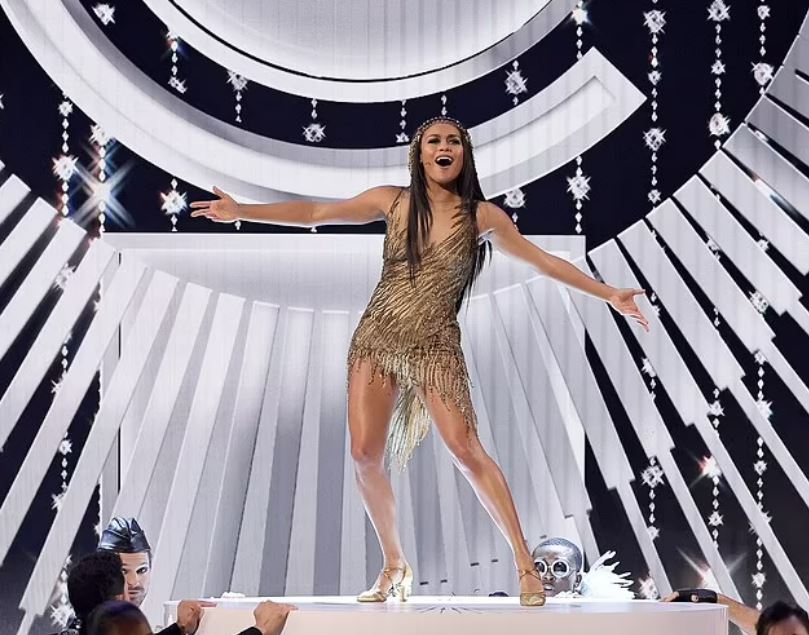
Ariana DeBose hosted again, and right away people had opinions about her opening number and monologue. Succession’s eldest boy, Jeremy Strong, got the awards started on a high note with his win for his role in the Ibsen play, An Enemy of the People. Then Jay-Z surprised everyone by joining Alicia Keys for “Empire State of Mind” following the Hell’s Kitchen musical performance. There were lots of other fun and touching moments, including Daniel Radcliffe and Jonathan Groff’s wins for Merrily We Roll Along and playwright Brandon Jacobs-Jenkins acceptance speech for Best Revival of a Play for his brilliant Appropriate. But nothing got people talking more than Eddie Redmayne’s on stage performance as the Emcee in Cabaret at the Kit Kat Club.
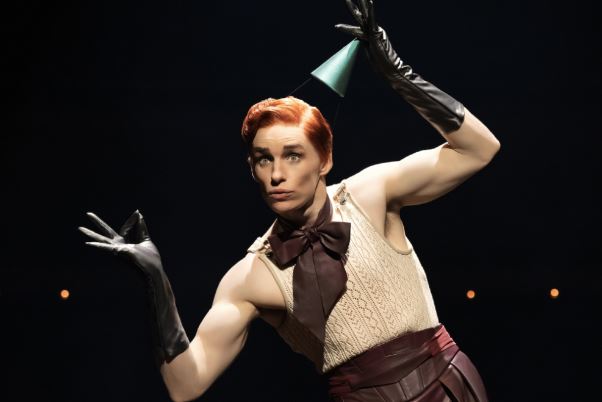
Redmayne’s interpretation of the character has been called everything from a “sleep paralysis demon” to “a steampunk Gollum lost in Weimar Berlin.” The extreme close-up of his performance was meant to mimic the immersive, “in the round” theatre experience where the audience is seated amid the action on stage, but people on Twitter had visceral reactions, to say the least. From my perspective, it genuinely seemed like this was a lot of people’s first experience with Cabaret, and so they lacked the understanding that this character is supposed to be unsettling and somewhat creepy. Still, others were definitely familiar with the film version, and a few had some knowledge of the original Broadway production and previous revivals. This one came to Broadway from London’s West End and has likewise divided critics and audiences alike. In short, viewers either loved or hated it. Mostly the latter, but people are still talking about it! Honestly, I can’t recall a moment in the years since I’ve been watching the Tonys that has ever inspired quite this much discourse.
I am a camera with its shutter open, quite passive, recording, not thinking.
I’m also not sure that any moment has ever captured Christopher Isherwood’s line from Goodbye to Berlin quite so perfectly before. The novel is part of Isherwood’s The Berlin Stories, which was the basis for the play I Am A Camera and later Cabaret. There’s also a film of the play. I first saw the film of Cabaret in college, and I was fortunate to have a good friend at the time who schooled me in the fascinating journey from the page to the stage and screen. For a crash course in the whole story I highly recommend watching Matt Baume’s summary on YouTube, Cabaret & the Seductive Power of Evil. There’s so much history with Cabaret, and he does an excellent job of tying it all together in just over fifty minutes—no small feat for such a multi-layered musical!
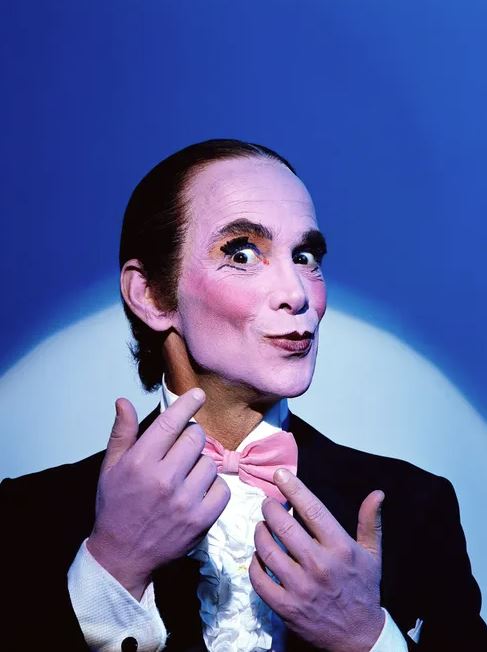
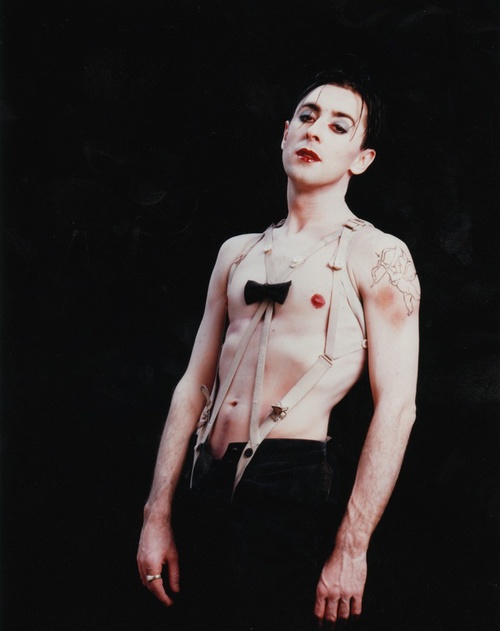
Certainly Joel Grey set the standard for the Emcee as he originated the role on Broadway and reprised it for the film. Redmayne shared in an interview that “Joel had sent me flowers welcoming me to the Emcee family” on opening night in London. Alan Cumming’s portrayal in the 1998 Broadway revival is the next most recognizable portrayal of the character, and it’s the one that’s been seen most often on stage in the production by Sam Mendes. The Emcee has also been played on Broadway over the years by Neil Patrick Harris, Michael C. Hall, and Raul Esparza, to name a few. On the West End, Mason Alexander Park became the first out trans person to headline Cabaret in 2023 with Jake Shears from Scissor Sisters taking over for a stint earlier this year. Just as the Mendes production made the Emcee into an overtly sexual character with much more revealing costumes so has the current one helmed by Rebecca Frecknell transformed him once again. An entire essay could be written about the lineage of these portrayals and probably somebody already has, but it’s been fascinating to see people interpret Redmayne’s performance as “sexless” and “very uninspired” as a few have called it on Twitter. Someone else pointed out that “it is supposed to be unsettline but the Emcee is supposed to reflect the degrading of German society, so the opening number should be genuinely fun and lively and then the character becomes more unhinged…as the show goes on and Nazism takes over.” Exactly.
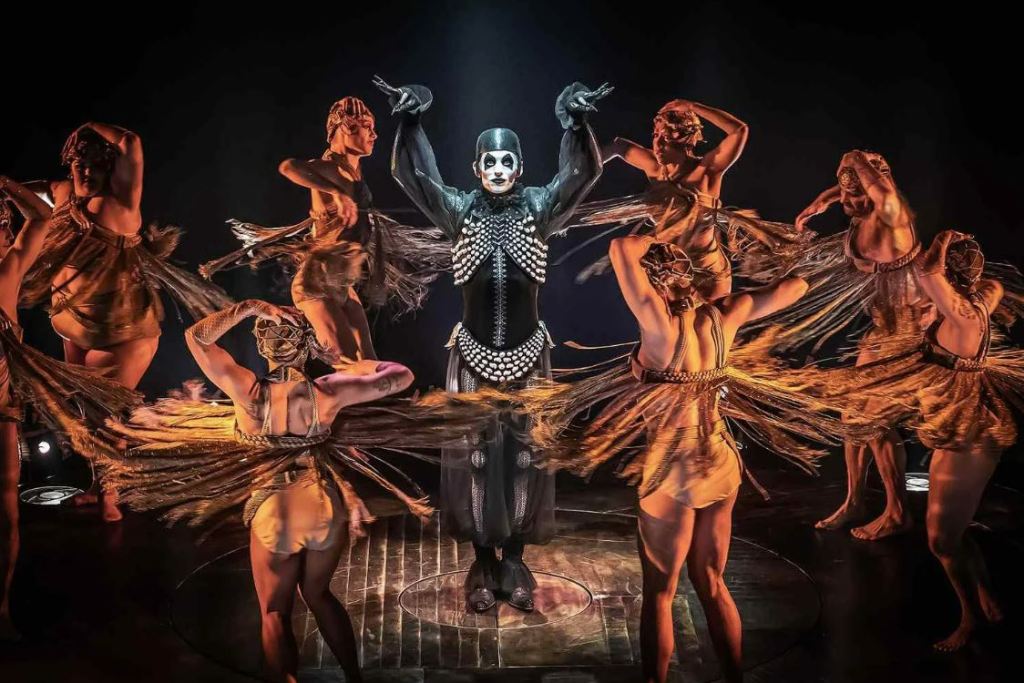
It’s important to remember that although the performances on the Tonys are the only chance that most people get to see something from a Broadway show they’re still out of context from the shows as a whole. Tony nominated costume designer for Cabaret at the Kit Kat Club, Tom Scutt, noted that “the show’s casting of Redmayne wasn’t without controversy, around the traditional view of the Emcee as a queer character,” but it more than achieves the effect in “getting there by wearing costumes which epxlore the the themes of opression and dominance,” including the gruesomely gorgeous skeleton get up from the “Money” number above. Someone somewhere along the commentary way wrote that they didn’t think it was necessary to know very much of the history behind the story of Cabaret to enjoy it and, while that may be true on the surface, I think knowing that history is crucial to truly understand all that it has to offer.

Isherwood published Goodbye to Berlin in 1939, and its quiet revelations about the rise of fascism that were so prescient then have become more relevant than ever. More importantly, if “those who cannot remember the past are condemned to repeat it,” as George Santayana wrote in 1905, then this performance of Cabaret has certainly done its job in getting people talking. A couple of days after the Tony Awards as people were still dissecting Redmayne’s interpretation, someone on Twitter astutely observed how “millimeter by millimeter he comes to the shape of a swastika” while contorting himself as he sings “Wilkommen.” Still others questioned the confusion surrounding the character, musing about the fact the Emcee is supposed to be creepy and unsettling. Indeed, “Wilkommen” is the opening number and an introduction to the debauchery that’s a cover for what happens in the progression of Cabaret. As above, the Emcee’s performances of “Money” and later, the especially unnerving and shocking “If You Could See Her (The Gorilla Song)” are integral to showing the horrors wrought by antisemitism and the Nazis. The “Willkommen (Reprise)” at the end is just as important, if not more so, as the beginning.
Outside it is Winter, but in here, it is so hot! Every night we have to battle with the girls to keep them from taking off all their clothes. So, don’t go away. Who knows, tonight, we may lose the battle. . .
Further reading:
The Untold History of Cabaret: Revised and Kicking
Cabaret (Music on Film series) by Stephen Tropiano
The Making of Cabaret by Keith Garebian
Cabaret FAQ: All That’s Left to Know About the Broadway and Cinema Classic by June Sawyers
 Literary Devices